

Human Rights and Dementia
People living with dementia and their carers have the same human rights as every other citizen. Whether it is the right to education, the right to travel, or the right to housing, human rights are universal and apply to all persons. The founding statement of human rights is the Universal Declaration of Human Rights (UDHR), launched in 1948.

Where, after all, do universal human rights begin? In small places close to home.
Eleanor Roosevelt, 1958
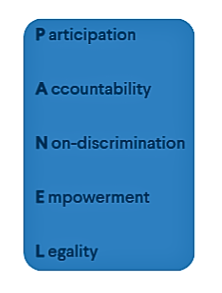
The PANEL principles provide a framework to keep in mind when promoting respect for the rights of people living with dementia.
Below are examples of how the rights of people living with dementia and their carers can be respected under this framework. For more information, see the ASI Charter of Rights for People with Dementia.
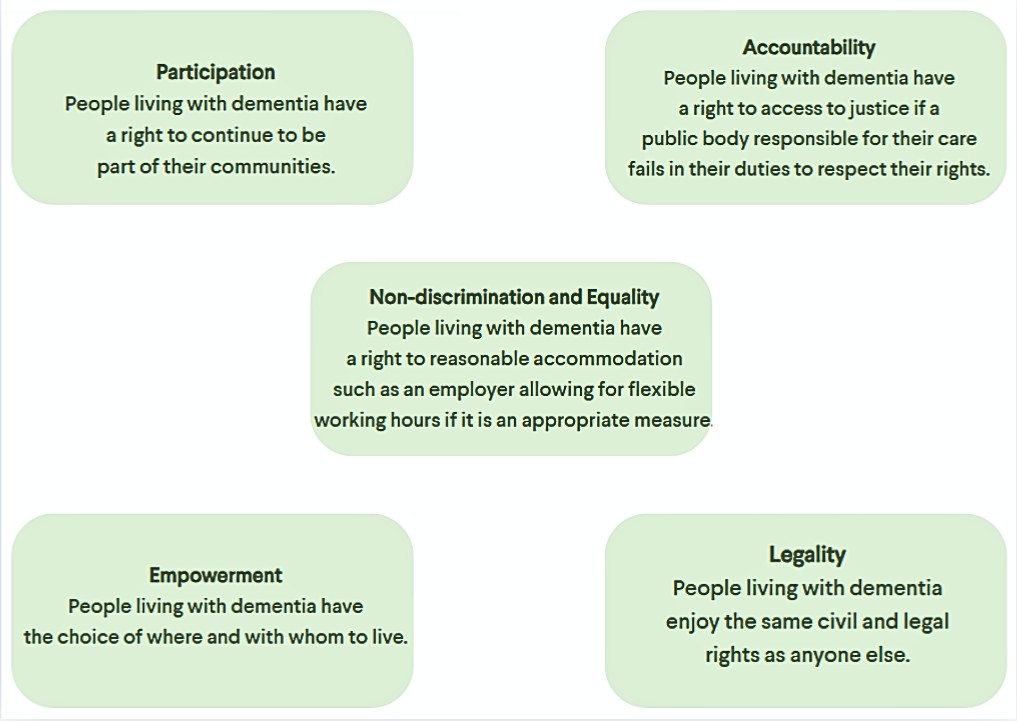
The Charter of Rights for People with Dementia
In April 2016, The Alzheimer Society of Ireland and the Irish Dementia Working Group published a Charter of Rights highlighting the rights of people with dementia.
The Charter calls for greater participation, accountability, equality, empowerment, and legal recognition for the rights of people with dementia.
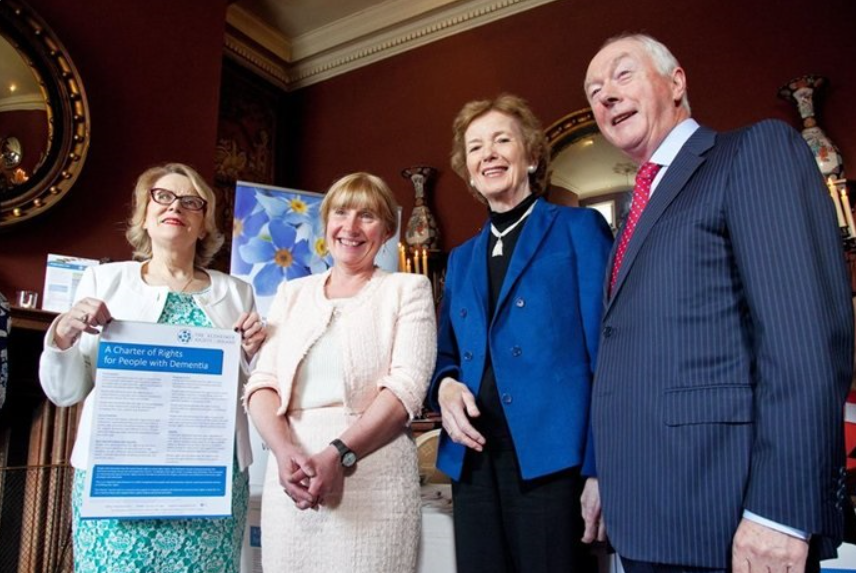
L-R: Helen Rochford-Brennan, Former Chair of the Irish Dementia Working Group, Colette Kelleher, former ASI CEO, former President Mary Robinson, and John Clifford, former Chairman of the ASI Board, at the launch of A Charter of Rights for People with Dementia on 7th April 2016.
I hope that the launch of this Charter will enable us all to see people with dementia in a new light, with the same human rights as all of us and with a voice that needs to be heard. It was a significant step to see the importance of using a human rights lens because that would empower those with dementia to be as involved as possible in addressing the challenges. That is what has happened and that is what this Charter is all about.
Former President of Ireland Mary Robinson, launching the Charter
You can download a copy of the Charter here and watch the video that features members of the Irish Dementia Working Group.
Our Lives, Our Rights Video
European and International Human Rights

UN Convention of the Rights of People with Disabilities (UN CRPD)
Dementia is recognised as a disability under the United Nations Convention on the Rights of People with Disabilities (UN CRPD). However, The Alzheimer Society of Ireland notes from anecdotal feedback that people living with dementia often face difficulties in accessing social protection for people with disabilities.
The UN CRPD is an international human rights treaty, designed to promote, protect and ensure the full and equal enjoyments of all human rights by all people with disabilities. It was adopted by the UN General Assembly in 2006. The Irish Government signed the UN CRPD in 2007, and ratified it in March 2018.
The UN CRPD affirms that individuals with disabilities are entitled to the full range of human rights enjoyed by those without disabilities. For people living with dementia, this means having access to community, support, health and care services from early symptoms to end of life. This includes the right to:
- Respect for inherent dignity, autonomy and freedom to make choices and independence (Article 3)
- Access to the physical environment (Article 9)
- Equal treatment before the law (Article 12)
- Independent living (Article 19)
- The highest attainable health standard (Article 25)
- Habilitation and service supports (Article 26)
- Employment (Article 27)
The UN CRPD reinforces that people living with dementia are entitled to equal rights, autonomy, and full participation in society, supported through appropriate services and legal protections.

European Convention on Human Rights (ECHR)
The European Convention on Human Rights (ECHR) is an international human rights treaty adopted by the Council of Europe. The ECHR provides a strong legal framework requiring states to safeguard the fundamental rights of people living with dementia.
As a member of the Council of Europe, Ireland is bound to respect the ECHR. The European Court of Human Rights is an international court which interprets the ECHR and is based in Strasbourg, France.
The ECHR contains a range of fundamental rights which apply equally to all persons within the jurisdiction of the Council of Europe. Some of the most relevant articles for people living with dementia include the right to life (Article 2), the right not to be tortured or subjected to inhuman and degrading treatment (Article 3), the right to liberty and security (Article 5), the right to have private and family life respected (Article 8), and the right to not be discriminated against (Article 14)
Equality Law
There are two main equality law Acts in Ireland:
- The Equal Status Acts 2000-2011
- The Employment Equality Acts 1998-2011
Disability is a recognised ground of discrimination under these Equality Acts. As dementia is a disability, these laws protect people living with dementia when they are buying goods, using services, and at work.
‘Discrimination’ has a specific meaning in the Equality Acts. In general, it means that a retailer, a service provider or an employer cannot treat you differently because of your dementia.
You have a right to ‘reasonable accommodation,’ which means that measures need to be taken to enable a person with a disability to use a service, access employment, or buy goods. For example, it may require a service provider to put in place services or special facilities to make it easier for you to use, such as the provision of a ramp if you are a wheelchair-user.
'Rights Made Real' Training Course
Following a successful application to the Irish Human Rights and Equality Commission, The Irish Dementia Working Group commissioned Prof Suzanne Cahill to collaborate with the group to develop training for people living with dementia to learn more about their human rights. This was delivered and adapted by an external facilitator, known as the “Rights Made Real” training course.
Read our Evaluation Report of the Rights Made Real training course for people living with dementia here.
Adult Safeguarding and People with Dementia in Nursing Homes

This report on safeguarding the human rights of people with dementia who live in residential care was commissioned by the Irish Dementia Working Group. It provides insights and recommendations into ways to uphold the rights of people with dementia as their care needs progress and they move to long term care. The report was published in December 2022.
Author: Dr Sarah Donnelly, Assistant Professor of Social Work, School of Social Policy, Social Work and Social Justice, UCD
Read the paper here.
Additional Resources
European and International Human Rights
- Links to the UNCRPD in different formats, and other useful links:
- Links to the ECHR in different formats:
Documents
- WHO, Ensuring a Human Rights Based Approach for People Living with Dementia
- The Alzheimer Society of Ireland. (2013). Human rights and older people in Ireland. The Alzheimer Society of Ireland.
Texts
- Suzanne Cahill, Fiona Kelly, Helen Rochford-Brennan (2025) Human Rights in Dementia Care: A Good Practice Guide Jessica Kingsley Publishers
Podcast Episodes